6 October 2025
Mary E. Brunkow, Fred Ramsdell and Shimon Sakaguchi are awarded the 2025 Nobel Prize in Physiology or Medicine “for their discoveries concerning peripheral immune tolerance”. Wojciech Michno and Marcel Tarbier of the Young Academy of Sweden answer five questions about this year’s prize.
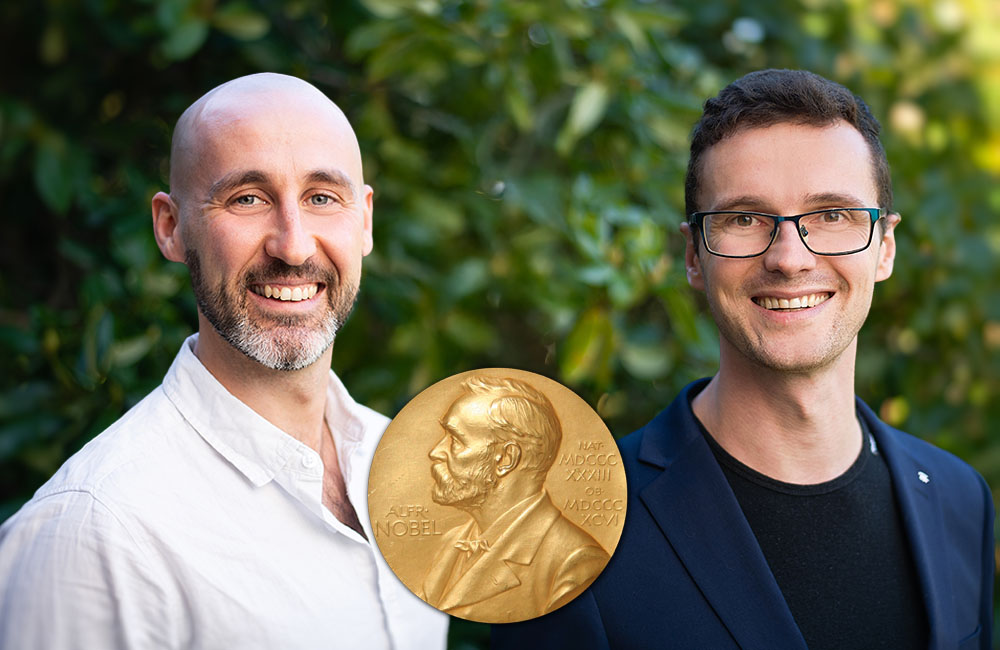
Wojciech Michno and Marcel Tarbier Photo: Erik Thor/Young Academy of Sweden
Press release: The 2025 Nobel Prize in Physiology or Medicine
Wojciech Michno is Assistant Professor in stem cell biology and neurochemistry at Uppsala University and a SciLifeLab Fellow. Marcel Tarbier is Assistant Professor in data-driven bioscience for precision medicine and diagnostics at the Department of Immunology, Genetics and Pathology and the Science for Life Laboratory, Uppsala University. Both are members of the Young Academy of Sweden for the period 2025–2030.
Marcel: My research focuses on the vast diversity of individual cells and their molecular profiles across different tissues, using high-throughput technologies – which links indirectly to this year’s prize. At the same time, one should not forget that nearly all research conducted today, from large-scale molecular studies to AI-driven models, “stands on the shoulders of giants”. This year’s Laureates are among those giants who, driven by curiosity, uncovered fundamental aspects of our immune system and transformed how we approach similar biological questions. It is thanks to their work, and that of many others who have mapped cell types and their functions through innovative and painstaking research, that today’s breakthroughs in molecular and systems biology have become possible.
Wojciech: Very much so. In my work, we study the cellular microenvironments of the brain, and it is becoming increasingly clear that regulatory T cells may play a decisive role there as well. It is fascinating to consider that the same mechanisms that keep the immune system in check throughout the body could also help protect neurons and maintain balance in the brain’s environment. This year’s prize highlights precisely this finely tuned regulation, which is becoming ever more relevant to neuroscience and neuroimmunology.
Marcel: Regulatory T cells play a crucial role in preventing the body from attacking itself. When that mechanism falters, it can result in severe autoimmune diseases. At the same time, cancer cells can exploit these T cells to mask themselves and evade immune detection. This is why regulatory T cells are now a highly active area of research – both to dampen autoimmune reactions and to improve cancer therapies. The knowledge gained about this key subset of immune cells has supported researchers across many neighbouring fields and opened new pathways for improving patient care.
Wojciech: The prize underscores how dependent our health is on the precision of the immune system. It is a field where the line between health and disease is exceptionally thin, and this year’s laureates have helped us understand why that balance usually holds so remarkably well.
Marcel: I think the Nobel Committee for Physiology or Medicine has made an excellent choice, once again highlighting the importance of fundamental research. The prize is not awarded for developing a treatment, but for deepening our understanding of the immune system and thereby laying the groundwork for future therapies. That matters: if we focus too heavily on application and immediate results, we risk overlooking the basic discoveries that make future breakthroughs possible.
Wojciech: An excellent choice. It brings together decades of research on the immune system’s balance between defence and tolerance. I particularly appreciate that the prize draws attention to the importance of control and restraint within a system otherwise built for attack. It reminds us that we sometimes need to look at systemic imbalance rather than seek simple explanations in single factors.
Marcel: Nobel Laureates typically conduct pioneering work — and it appears even more impressive in hindsight, considering they lacked the analytical tools we have today. If I were to choose one example, I would highlight Peyton Rous and his discovery of tumour-inducing viruses. It was a revolutionary insight that certain viruses can, in fact, cause cancer — a field of research that, in my view, is essential for fully understanding the disease.
Rous’s story is also remarkable: he was first nominated in 1926 and at least sixteen times thereafter, but received the prize only in 1966 — a full 55 years after his discovery. Sometimes it simply takes time for the world to grasp the true significance of a finding.
Wojciech: I have always found the 2018 Nobel Prize awarded to James Allison and Tasuku Honjo for their discovery of cancer immunotherapy via inhibition of immune checkpoints particularly inspiring. It shows how a fundamental understanding of immune regulation can translate into entirely new treatment strategies. It also feels like a direct predecessor to this year’s prize, but focusing on the opposite side of the same coin, how we can either activate or suppress immune responses depending on what is needed.
Marcel: There are indeed countless discoveries that have transformed our understanding of the human body and biology more broadly, and that would be worthy of a Nobel Prize. I do not envy the Committee their task of choosing among them. It is worth remembering that the Nobel Prize is merely the tip of the iceberg, beneath the surface, extraordinary research is carried out every day, by scientists across a wide range of fields, collectively driving knowledge forward.
Wojciech: There are many discoveries in medicine and physiology that have not yet been recognised with a Nobel Prize. I am particularly thinking of research on the body’s own mechanisms of recovery and repair: how tissues heal, how cells restore balance, and how different organ systems work together to maintain health. Such research often sits at the intersection of several fields, but has enormous implications for future treatments.
Latest news from the Young Academy of Sweden, published approximately six times a year. You can unsubscribe at any time.


5 Questions to Jessica Jewell about the 2025 Economics Prize