4 March 2026
Academic freedom and the EU’s role in research were the focus when the Young Academy of Sweden gathered in Brussels for this year’s first academy meeting in early March. During two intensive days, the academy networked with its Belgian counterpart, Jonge Academie, visited the European Parliament, and gained insight into how the Commission works.
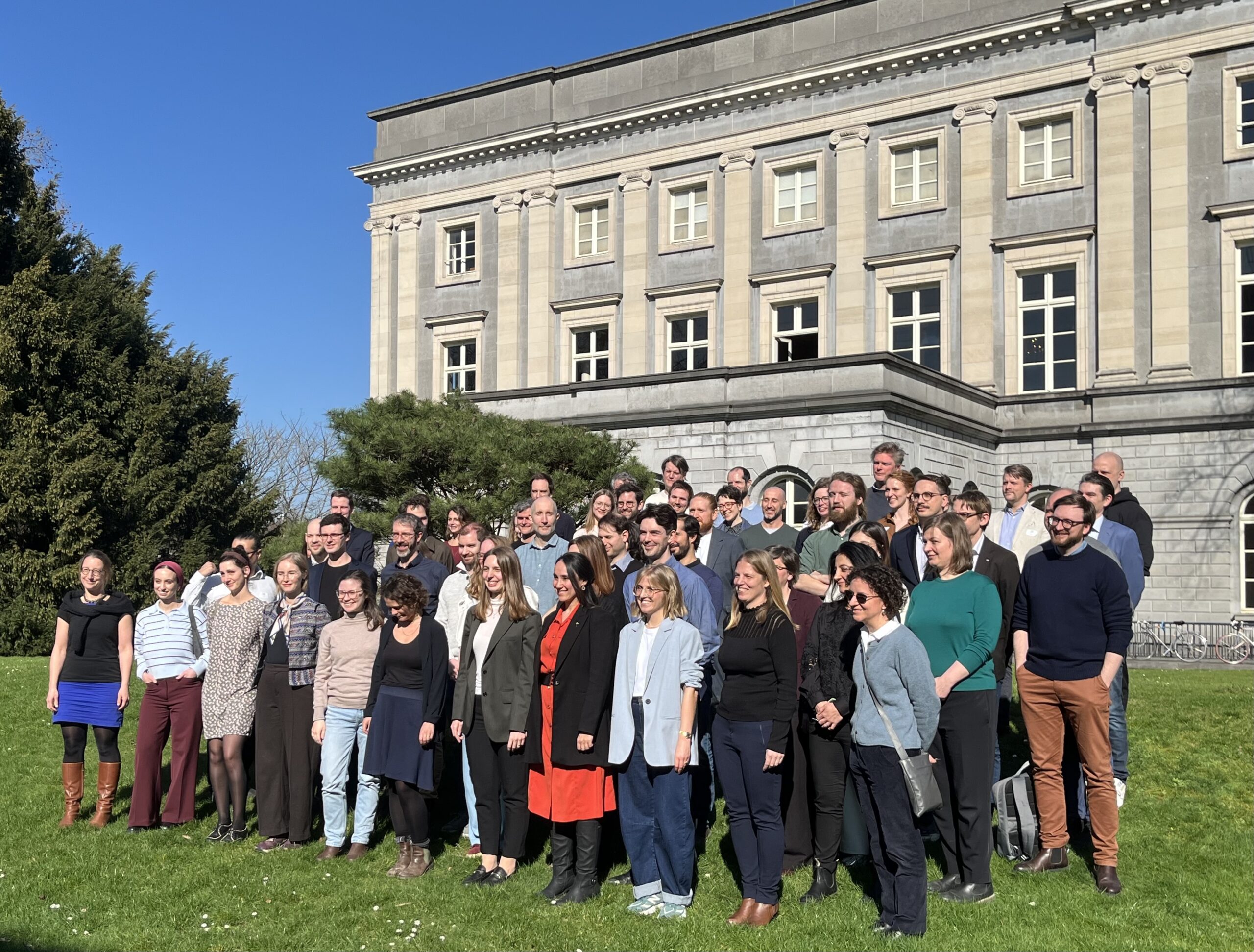
The Young Academy of Sweden and Jonge Academie gathered outside the Paleis der Academiën in central Brussels. Photo: The Young Academy of Sweden
The Young Academy received a grand welcome from its Belgian counterpart, who hosted the event in the beautiful Palace of Academies (Paleis der Academiën) in central Brussels. The joint meeting began with presentations of each organisation’s activities. The Belgian academy was represented by Sven Rogge and Zoë Ghyselinck, and the Young Academy of Sweden by chair Gabriele Messori. This was followed by group discussions on two themes: caring science and artificial intelligence and its consequences for research and academic freedom.


In the afternoon, the Young Academy participated in the Jonge Academies’ anniversary, where new members were installed. In connection with the anniversary celebration, a public event about academic freedom was also held, where the members of the Young Academy Elham Rostami and David Marlevi took part as speakers. Elham Rostami gave a speech where she among other things talked about the academy’s initiative Stockholm Charter for Academic Freedom and David Marlevi participated in a panel discussion.
Academic freedom is a cornerstone for research and societal development, but freedom is not a given, several speakers emphasised. Developments in other countries – for example Hungary, Argentina and the USA – illustrate how quickly the conditions for research can change when political or institutional circumstances shift. At the same time, both Sweden and Belgium rank highly in international comparisons of academic freedom, which places a particular responsibility on the research community to protect independent research and contribute to an open scientific debate.


The second day was devoted to the EU’s role in research policy. The academy was visited, among others, by Sophia Eriksson Waterschoot, Deputy Director-General at the Directorate-General for Communication, who gave an insight into how the Commission works and how the EU’s research initiatives are communicated to researchers and the public.
The EU is in a geopolitically complex situation, she emphasised, with increased tensions in the world and major political changes globally. In this context, the EU tries to maintain stability, cooperation and long-term strategies, including by strengthening competitiveness, innovation and international partnerships. An important issue going forward is how Europe can continue to be attractive to researchers, not least in a situation where researchers in other parts of the world are increasingly seeking to move to our latitudes.
The academy also met representatives from Sweden’s research and innovation office in Brussels, SWERI, who spoke about current processes within the EU’s research policy. Among other things, they discussed work on the EU’s upcoming framework programme for research and innovation, FP10, as well as legislation linked to the European Research Area, the so-called ERA Act. These initiatives are expected to have great significance for how European research is financed and organised in the coming years.


At the end of the day, the academy visited the EU Parliament where we met with the MEP Sofie Eriksson (S), member of the Committee on Industry, Research and Energy, ITRE. The conversation covered, among other things, the EU’s research budget, the design of FP10, and how research policy affects Swedish researchers. The discussion also touched on how the EU can strengthen innovation, entrepreneurship, and research collaborations in a time characterised by global competition.
The academy meeting in Brussels provided members the opportunity to deepen collaboration with the Belgian young academy and to gain a better understanding of how EU research policy is shaped. The meeting clarified that academic freedom and good conditions for research cannot be taken for granted, but also that international networks between researchers and academies are an important part of safeguarding these values.


Latest news from the Young Academy of Sweden, published approximately six times a year. You can unsubscribe at any time.


