3 november 2026
How can research systems better support early-career researchers, protect academic freedom and foster international collaboration? These questions were at the centre of the fifth bilateral symposium between The Young Academy of Sweden and the Young Korean Academy of Science and Technology (Y-KAST), held in South Korea in October.
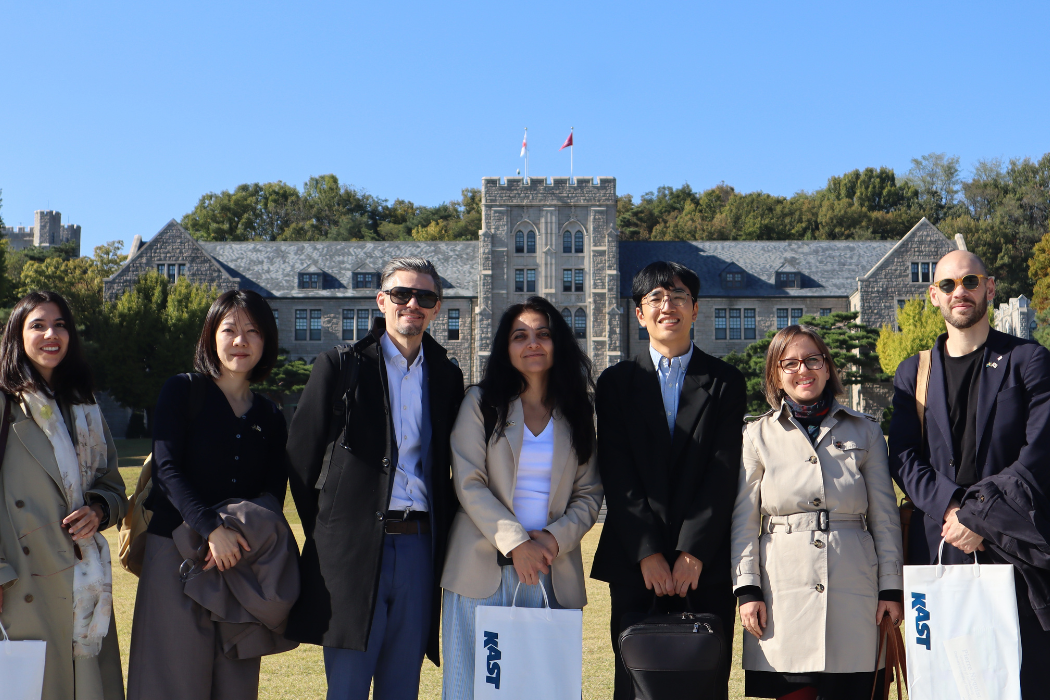
Group photo from The Young Academy of Sweden’s visit to South Korea, October 2026. Photo: The Young Academy of Sweden.
The visit brought together researchers from both academies to exchange experiences, explore opportunities for collaboration and identify lessons for research policy in Sweden and South Korea.
The Young Academy of Sweden was represented by Pierre Nyquist, Laura Bacete Cano, Iva Lučić, Juan C. Rocha and Elham B. Rostami, as well as Sverker Lundin, Chief Executive Officer, and Kevin Perera, International Coordinator, from the secretariat.
“In an increasingly divided world, scientific collaboration is more important than ever. Science builds bridges and young academies have an important role to play,” says Elham B. Rostami, Chair of The Young Academy of Sweden.
A central theme throughout the visit was how research systems can provide better conditions for early-career researchers. Discussions explored the balance between strategically prioritised research and curiosity-driven research, as well as the importance of stable, long-term funding that allows researchers to develop new ideas and pursue ambitious questions.
The exchange built on the academies’ existing collaboration, including a joint report on curiosity-driven and agenda-driven research, which examined research funding approaches in Sweden and South Korea and how members of the two academies perceive them.
Experiences from South Korea highlighted the potential consequences of sudden changes in research funding. Following significant budget cuts in 2024, some research groups that lost their funding were unable to re-establish themselves even after funding became available again. The discussions underscored how interruptions can lead to lasting losses of expertise and research capacity.
“The damage caused by sudden funding cuts is not temporary. When research groups lose their funding and disperse, the people, expertise and continuity cannot simply be brought back the following year,” says Laura Bacete Cano, reflecting on the lessons from the visit.
The academies also discussed research evaluation, career paths beyond the professorship and how funding systems can better support scientific creativity and academic freedom.
“There is indeed a shared demand for long-term curiosity-based funding opportunities in our research systems, as well as support and incentives for mobility and international collaboration,” says Sverker Lundin.


The programme included visits to Korea University, the National Research Foundation of Korea and the Artificial Intelligence Institute at Seoul National University. These meetings provided insights into South Korea’s research priorities, funding programmes and approaches to international collaboration.
At Seoul National University, the delegation explored how AI research can be integrated with a broad range of disciplines, including the humanities and social sciences. The discussions also highlighted the importance of developing AI literacy beyond specialised technical fields, for example through educational initiatives. The close cooperation between academia and industry in Korea was also noted. This would enable more effective engagement with the technology, among researchers and the wider society alike.
“What struck me was the openness towards AI across disciplines. Even in the humanities, a proactive and open approach can help us explore new applications while safeguarding academic integrity,” says Iva Lučić.
The visit raised opportunities for further exchange on interdisciplinary AI research and its societal implications, as well as on how international collaboration can help researchers address shared challenges.


An important outcome of the visit was the opportunity to explore more structured cooperation between the two countries. The academies discussed the potential for a Sweden–South Korea researcher mobility programme that could support exchanges at different stages of an academic career, from students and postdoctoral researchers to established researchers and research groups.
“International mobility should not be limited to one stage of an academic career. Supporting exchanges between senior researchers and their groups can help build lasting collaborations across generations,” says Elham B. Rostami.
Such initiatives could help turn individual contacts into lasting partnerships, strengthen international research networks and create opportunities for joint projects.
The Swedish Embassy in Seoul also played an important role in facilitating meetings and connections during the visit, demonstrating how scientific diplomacy can bring together academies, universities and research funders
The insights gained will feed into The Young Academy of Sweden’s continued work on research policy, including its input to the Swedish government ahead of the next research policy bill. The academies will also explore opportunities to continue their exchange through joint activities, workshops and initiatives supporting international research collaboration.



Fyll i formuläret för att få Sveriges unga akademis nyhetsbrev. Det utkommer upp till sex gånger per år. Du kan närsomhelst välja att avsluta din prenumeration.


